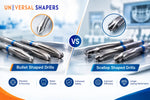
How Scallop-Shaped Drills Enhance Precision in Dental Implant Procedures
Precision in implant dentistry does not end once the osteotomy reaches its planned depth. What happens at the crestal bone in the final moments of drilling shapes how well soft tissue heals and how cleanly a restoration seats. At Universal Shapers, we engineer our scallop shaped drills specifically for this stage, giving you a level of control over crestal bone architecture that a standard drill cannot provide on its own.
In this article, we explain what sets our scallop shaped drills apart from a standard osteotomy drill, and where this step belongs within your broader drilling sequence. We also look at why we build crestal contouring into our kits as a standard component rather than an optional add-on.
What Makes Scallop Shaped Drills Different
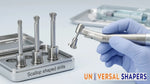
A conventional osteotomy drill finishes its job by leaving a flat, uniform rim at the top of the implant site. We designed our scallop shaped drills to pick up where that drill leaves off, contouring the crestal bone into a scalloped profile that mirrors the natural architecture found around healthy teeth.
A few design features set our scallop shaped drills apart:
-
A flared, contoured cutting surface built specifically for crestal bone shaping
-
A geometry that engages bone progressively rather than removing it all at once
-
Consistent tolerances across every drill in the set, so each pass produces a predictable contour
We manufacture this geometry to a tight tolerance, since even small inconsistencies at this stage can translate into uneven bone contouring around the implant platform.
This attention to geometry reflects a broader shift in implant instrumentation. Where a single drill type once handled every stage of site preparation, modern protocols increasingly rely on purpose-built instruments for each specific task. Crestal contouring is one of the clearer examples of this shift, since asking a general-purpose osteotomy drill to shape delicate crestal architecture puts it well outside the job it was designed to do.
How Scallop Shaped Drills Improve Precision at the Crestal Bone
Precision at the crestal bone comes down to control over two things: how much bone you remove, and where you remove it. Our scallop shaped drills give you that control by targeting only the coronal portion of the site, rather than reshaping the entire osteotomy.
What this level of precision supports clinically:
-
A more natural transition between the implant platform and the surrounding bone
-
A defined seating surface for healing abutments and cover screws
-
Additional space for soft tissue to develop around the implant collar
-
A consistent bone profile across multiple implants in the same arch
We hear from clinicians that this consistency matters most in cases where several implants need to align under a single prosthetic framework, since uneven crestal contouring at any one site can throw off the fit of the entire restoration.
Precision at this stage also affects how predictably the site heals. A crestal contour that varies from implant to implant within the same arch tends to produce uneven soft tissue response, which can complicate impression taking and final restoration fit weeks or months later. Building consistent contouring into every case, rather than only the ones where it feels necessary, reduces this variability across your practice.
The Role of Scallop Shaped Drills Within a Complete Drilling Sequence
Bone drilling for dental implants follows a sequence, and we designed our scallop shaped drills to occupy a specific place within it rather than replace any step that comes before them.
A typical sequence looks like this:
-
Pilot and progressive osteotomy drills establish the implant site to the planned depth and diameter
-
Bullet-shaped or self-centring drills refine entry point accuracy where needed
-
Scallop shaped drills contour the crestal bone once the osteotomy is complete
-
You place the implant into the profiled site
We recommend treating this final step as a defined part of your sequence rather than an optional finishing touch. Skipping it, or introducing it out of order, reduces the precision benefit the drill is designed to provide. At Universal Shapers, we design our sequencing guidance around this exact principle, since a scallop shaped drill performs best when it arrives at the point in the procedure it was built for, not whenever time allows.
Why Scallop Shaped Drills Belong in Modern Dental Implant Surgical Kits
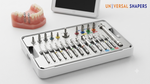
We build our scallop shaped drills directly into our dental implant surgical kits, rather than offering them as a separate purchase disconnected from your core osteotomy drills. This matters because precision depends on consistency across the entire sequence, not just one instrument.
What a coordinated kit gives you that a standalone drill cannot:
-
Matched diameters between your osteotomy drills and your scallop shaped drills
-
A single manufacturer's tolerance standard applied across every instrument you use
-
Clear sequencing guidance that shows exactly where crestal contouring fits into your protocol
-
Fewer instrument changes during surgery, which keeps your surgical field cleaner and your workflow faster
|
Kit Element |
Function |
Precision Benefit |
|
Osteotomy drills |
Establish core implant site |
Accurate depth and diameter |
|
Bullet-shaped drills |
Improve entry point centring |
Reduced drift at initiation |
|
Scallop shaped drills |
Contour crestal bone |
Consistent, natural bone profile |
|
Depth and stop components |
Confirm planned depth |
Repeatable results across cases |
We coordinate every element in our dental implant surgical kits around this same standard, so precision carries through from the first drill to the last.
Clinical Situations Where Precision Contouring Matters Most
Crestal contouring with scallop shaped drills adds the most value in specific clinical situations, though many clinicians build it into their standard protocol regardless of case type.
-
Esthetic zone cases, where visible soft tissue contour affects the final appearance
-
Immediate implant placement, where the extraction site benefits from additional shaping
-
Full-arch and multi-unit abutment cases, where consistent contouring supports even seating across several implants
-
Cases using healing abutments or prosthetic components that need a well-defined bone platform
In cases with thick soft tissue biotype or minimal esthetic demand, the benefit may be smaller, though the added step still takes little time within your overall sequence. Many of the practices we work with choose to apply crestal contouring across their full caseload rather than reserving it for select situations, simply because the consistency it adds rarely comes at a meaningful cost in chair time.
How We Engineer Precision Into Our Scallop Shaped Drills
Precision starts on our manufacturing floor, not just in your operatory. We hold our scallop shaped drills to tight tolerances across the full set, so the cutting geometry you rely on for one drill matches every other drill in that same kit.
We test our drills for consistent performance across repeated sterilization cycles, since a drill that changes shape or cutting behavior after multiple autoclave cycles undermines the precision it was designed to deliver in the first place. We also document our recommended speed and irrigation settings clearly, so the technique you use with our drills stays consistent with how we engineered them to perform.
We believe this attention to manufacturing detail is what separates a scallop shaped drill that reliably improves precision from one that simply looks similar on the surface. It is also why we treat crestal contouring as a core part of our product line at Universal Shapers, rather than a secondary accessory sold alongside our main drill sets.
Conclusion
Precision in implant dentistry depends on more than accurate depth and angulation. The final contour of the crestal bone plays a direct role in soft tissue healing, prosthetic seating, and long-term stability around the implant. Our scallop shaped drills give you control over that final stage, working alongside your existing bone drilling for dental implants sequence rather than replacing any part of it.
We build these drills into our dental implant surgical kits as a coordinated system, so precision carries through your entire protocol from the first osteotomy drill to the final contouring step.
Explore our full range of scallop shaped drills and complete surgical kits at universalshapers.com, engineered for the precision your implant procedures depend on.