Guided Implant Surgery: Why Modern Dentists Are Switching to Precision Drilling Systems
For decades, dental implantology was a field defined by a high degree of manual skill and, frankly, a bit of guesswork. Even the most seasoned surgeons had to rely on their eyes and steady hands to place a titanium post into a three-dimensional bone structure that they could only see in two dimensions on a traditional X-ray. It was effective, sure, but it was not always perfect.
In 2026, the game has changed. We are no longer in the era of eyeballing it. If you are a dentist still placing implants entirely by freehand, you are working harder than you need to and taking risks that your patients no longer expect. The shift toward guided implant surgery is not just a trend; it is a fundamental move toward a higher standard of care. This transition is being driven by precision drilling systems that take the mystery out of the procedure and replace it with mathematical certainty.
The Death of Freehand Surgery
Let’s be blunt: freehand surgery is becoming a liability. No matter how many thousands of implants you have placed, the human eye has limitations. You are dealing with sub-millimeter tolerances. A slight tilt of the wrist or a minor miscalculation of bone density can lead to an implant that is slightly out of alignment. This might not cause a failure on day one, but it creates massive headaches when it is time to place the crown.
Modern dentists are switching to guided systems because they want to sleep better at night. When you have a digital workflow, you are planning the whole surgery before the patient even sits down in the chair on a computer. What you are viewing is the bone, the nerves, and the sinu cavities in high definition 3D. You are not simply making an implant, but a pre-determined scheme.
What is a Guided Surgical Kit Exactly?
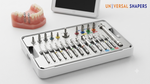
At the heart of this revolution is the guided-surgical-kit. For those who haven't made the switch yet, think of this kit as the bridge between your digital plan and the patient’s mouth.
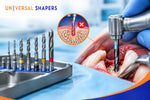
A traditional kit gives you the tools to cut bone, but a guided kit gives you the tools to follow a roadmap. These kits include specialized sleeves and drills that fit perfectly into a 3D-printed surgical guide. The guide sits on the patient’s teeth or gums, and the drills can only go exactly where you planned. They cannot tilt, and they cannot go too deep because of physical stops built into the system. It removes the stress of depth control and angulation entirely.
The Role of High Quality Instrumentation
Amazing software in the world can make you a victim of poor hardware, which is dull or not properly calibrated. This is why the search for the Best Implant drills is a top priority for modern clinics.
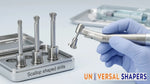
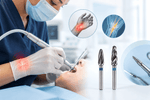
A good quality drill must remain sharp with repeated use and more. So, it must be heat-resistant. Bone is living tissue; if you heat it too much while drilling, it is killed. This leads to a lack of integration and a failed implant. The best drills are designed with advanced irrigation channels and metallurgy that keeps the temperature low even at high RPMs.
Anatomy of a Precision Drilling System
To understand why this is better, you have to look at the individual components of the system. It is not just one drill; it is a sequence of events designed to maximize primary stability.
The Initial Osteotomy
Everything starts with the pilot drill. In a guided system, this drill is stabilized by the guide sleeve, ensuring the entry point is perfect. From there, the sequence of drills gradually widens the hole. Because the guided-surgical-kit ensures each drill follows the exact path of the previous one, there is zero deviation.
The Importance of Implant Abutment Drills
Once the site is prepared, the focus shifts to how the prosthetic will actually sit. This is where Implant abutment drills come into play. These special instruments provide the advantage of curving the bone in the proper manner to accommodate more than the implant, but also the abutment, where the final tooth will be placed. In case the top of the bone is not formed in the right way, the abutment may not fit flat. Thus, bacterial traps or mechanical breakdowns may occur in the future. Accuracy is what comes in between a good and a great outcome at this point.
Why Patients are Demanding This Technology
Patients are more informed than ever. They are reading reviews, watching YouTube videos of procedures, and asking about the technology you use. When you tell a patient that you use a digital precision system, you are telling them three things:
- The surgery will be faster: The plan is already prepared. There will be no hesitation in the middle of the procedure. You are well aware of what you are doing.
- The recovery will be easier: Guided surgery is often less invasive. You don't always need to flap the gums open to see the bone because the guide tells you exactly where to go. Less trauma means less swelling and less pain.
- The result is predictable: The patients would like to believe that their new tooth would be natural and look natural. Guided surgery is the correct technique that guarantees a perfect restoration free of aesthetics and functionality.
The Economic Reality for the Modern Practice
Some dentists hesitate to switch because of the initial cost of the software and the kits. This is a short-sighted view. Consider the price of one implant failure. Think about the time lost trying to fix a prosthetic that does not fit because the implant was placed at a weird angle.
Guided surgery reduces chair time. It reduces the number of follow-up appointments. It increases the number of successful cases you can handle in a week. When you look at the ROI, the investment in a high-quality guided-surgical-kit and the Best Implant drills pays for itself within the first few months. You are trading your stress for a repeatable, scalable system.
Mastering the Learning Curve
Modern systems are becoming more intuitive. The drills are color coded, the kits are logically organized, and the support from manufacturers is better than it has ever been. We are moving toward a future where every implant placement is a non-event because the precision of the tools makes success the only logical outcome.
Conclusion: Setting the Standard
The transition to precision drilling systems is about more than just buying new toys. It is about an obsession with accuracy. With the further development of the technology, the divide between the dentists who use these systems and those who do not will further increase.
To the professional who is willing to take their practice to the next stage, the decision is obvious. You require appropriate equipment to correspond with your expertise. This is the reason why a lot of high-end surgeons are resorting to Universal Shaper to seek the special equipment necessary to carry out these high-precision procedures.
Investing in the appropriate kits and the best quality drills is not just keeping pace with the industry; it is leading the pack. Your patients deserve the certainty that comes with guided surgery, and your practice deserves the efficiency that modern technology provides. The days of guessing are over. It is time to embrace the era of precision.