How Innovative Drill Designs Enhance Surgical Control and Safety
In dental surgery, your hands are only as good as the tools you hold. You can have many years of training and a good understanding of the mouth's structure. But if you are using old drill designs, you are making your work much harder than it needs to be. Being precise is not just a fancy word in dentistry. It is the difference between a successful implant and a bad failure.
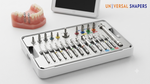
Dental surgery has changed quickly over time. We have moved from simple hand tools to advanced systems that put bone health and patient safety first. At Universal Shapers, the goal is to change the surgical method to make it simpler, safer, and much easier to predict. Here is why the design of your drills matters more than you think.
The Role of Drills in Modern Dentistry
In modern dentistry, the drill plays an essential role in cavity preparation, caries removal, and precise tooth structuring, yet many practitioners treat it like a simple commodity. It’s a mistake, as it is a precision cutting instrument that interacts with living tissue, and how it interacts with that tissue determines the long-term success of your procedures.
Beyond the Traditional Handpiece
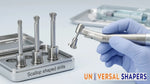
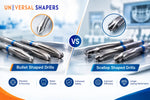
Old drills were often simple tools made only to make a hole. New drill designs are much more advanced. Today, we have special tools like scallop shaped drills. These are made to fix specific surgical problems. For example, they stop the drill from moving off the spot you want, and they help the implant stay firm from the start. Modern dentistry needs tools that let you feel what you are doing and give you very high accuracy.
Why Precision Matters in Dental Surgery
When you perform an osteotomy (cutting bone to place an implant), you are working in a very small space. There is no room for mistakes. If the drill moves even one millimeter off the path, you could damage nearby teeth or nerves.
Being precise also makes sure the hole you drill is exactly the right size for the implant. This is very important for two things: first, the implant must feel tight and stable right after placement, and second, the bone must grow tightly around the implant over time. If the fit is not right, the implant will have problems from the very start.
Common Risks with Outdated Drill Designs
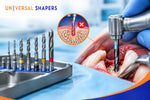
Old drill designs have many problems. The biggest problem is heat. Bone is very sensitive to temperature. When your drill creates too much friction, you can cause bone death. That is a sure way to make the implant fail.
Other risks include drill chatter. That is when the drill vibrates and makes an uneven hole. Another risk is skipping. That happens when the drill slides across the hard outer layer of the bone instead of going straight in.
Key Innovations Improving Control and Safety
Innovation does not only mean the incorporation of flashy lights and digital displays. It concerns cutting-edge geometry and the tool ergonomics.
Ergonomic Handpiece Designs for Reduced Fatigue
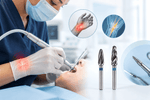
Dental surgery can be physically demanding. When a handpiece is not well balanced, the surgeon's hand gets tired. Then the surgeon loses the ability to make small, precise movements. Drill’s designs are made so that the balance point is shifted. This puts less stress on your wrist. This enables more steady movements and control in the case of long or complex cases.
Integrated Irrigation for Bone and Tissue Protection
Heat is the enemy of bone. The current drill designs are with an advanced irrigation system that provides coolant at the point of cutting. This is not just about keeping the drill cool. It is also about washing out the small pieces of bone and keeping the bone healthy. You must use cooling liquid when you perform deep bone work. This helps prevent heat damage to the hardest and thickest parts of the bone.
Speed Regulation and Optimization
Using the same speed and twisting force for every step is dangerous. Modern systems let you control each one very carefully. Marking the spot, widening the hole, and placing the implant all need different speeds.
Adjusting the twisting force helps the drill cut steadily without getting stuck or jumping. This gives the surgeon a smooth and predictable experience.
How These Designs Benefit Dental Procedures
The real benefit happens when these design features work together in a real surgery. Take the scallop shaped drills from Universal Shapers as an example. Old pointed drills often slide or "walk" across the bone surface before they start cutting. The scallop design touches the bone at several points at once. This helps the drill stay in place right away. In many cases, you do not even need a small starter drill. This makes sure the hole starts exactly where you want it.
When you reach the deeper parts of the bone, special cutting techniques help you enter the hard outer layer of the jawbone more precisely. These techniques reduce the amount of force needed to break through this hard layer. By doing this, you also lower the chance of causing tiny cracks in the bone around the area.The result is a cleaner work area, less harm to the patient, and a much shorter healing time.
Safety Features That Protect Patients and Practitioners
Safety in the operatory is a two way street. You need to protect the patient from trauma and yourself from procedural errors.
One of the most significant leaps in safety is the transition to guided surgery. A guided-surgical-kit acts as a GPS for your drills. By using a custom made surgical guide, you ensure that every drill in the sequence follows a predetermined path and depth. This virtually eliminates the risk of human error. It allows you to plan the surgery digitally and execute it with a level of confidence that freehand surgery simply cannot match.
Also, modern implant osteotomy drills often have depth marks that are made with a laser and are easy to see. In a surgery area that is covered with blood, being able to see clearly is very important. When you can look and know exactly how deep you are, that is a simple but very important safety feature. It stops you from drilling too deep and hurting the nerves.
Choosing the Right Drill System for Your Practice
So how do you decide which system is right for you? You need to look at the thinking behind the tools. Do they help the person who made them, or do they help you?
A good drill should feel natural to use. It should make your work easier, not harder. This is why many surgeons are switching to the kits from Universal Shapers. Their tools are made to reduce the number of steps in the surgery. For example, a special drill that does several jobs at once can save you time and reduce how many times you need to change tools during a procedure.
Look for a system that gives you a full guided surgery kit, if you want to take your practice to a higher level. Guided surgery is quickly becoming the new standard of care. A kit that works smoothly with your favorite implant brands is a very big improvement.
Conclusion
The tools you use show how much you care about your patients. Technology is getting better every day. When you use old drill designs, you are not helping yourself or your patients. New designs like the ones from Universal Shapers are not just nice extras. They are necessary parts of a modern, safe, and efficient dental practice.
When you buy special tools like scallop shaped drills and cortical release drills, you take better control of the surgery. You reduce risks. You get better results. And most importantly, you give a better experience to the person sitting in your chair. Being precise is the most basic part of dentistry. That precision is built one drill at a time.
If you are ready to stop fighting your tools and start working with them, it is time to see what modern engineering can do for your practice. Look at the full range of surgical tools from Universal Shapers. See how a change in drill design can change the way you do surgery.