Bullet Shaped Drills vs Conventional Implant Drills: Which Is Better for Modern Implant Procedures?
Choosing the right drill for implant site preparation shapes every stage of the procedure that follows. A well-designed drill influences how accurately the osteotomy tracks the planned trajectory, how much heat builds up in the bone, and how confidently a clinician moves through each step. Over the past decade, drill design has advanced considerably, and one of the more discussed innovations is the bullet shaped drill.
Dental professionals now have more options than the traditional cylindrical drills used for decades. Among the newer designs, bullet shaped implant drills have gained attention for their initial stability and guided drilling advantages. This article compares bullet shaped drills with conventional implant drills across the factors that matter most in daily practice.
Understanding Conventional Implant Drills
Conventional implant drills have been the backbone of implant dentistry for years. Most are cylindrical or slightly tapered, with flutes designed to remove bone efficiently as the drill advances into the osteotomy site.
Design characteristics
-
Straight or tapered shaft with a flat or pointed tip
-
Progressive diameter sequencing, from pilot drill through final diameter
-
Geometry built primarily for linear, depth-controlled cutting
Conventional drills are used across nearly every implant system, from single-tooth restorations to full-arch cases. They remain the default choice in many protocols because clinicians have decades of familiarity with their handling, and their straightforward design makes them easy to source and replace.
Common challenges during osteotomy preparation
-
Limited initial centring, which can let the drill tip walk across the cortical surface before it fully engages bone
-
Reduced stability at the start of drilling, especially in dense or uneven ridges
-
A higher chance of angulation drift when transferring a freehand or guided trajectory
-
Heat accumulation with extended drilling time in denser bone
These challenges do not make conventional drills unsuitable. They mean that outcomes depend heavily on operator skill, irrigation, and drilling speed.
What Are Bullet Shaped Implant Drills?
A bullet shaped implant drill takes its name from its rounded, tapering tip. Instead of a flat or aggressively pointed leading edge, the tip curves gradually, similar in profile to a bullet.
Unique design features
-
A rounded, tapering tip that narrows gradually into the shaft
-
Cutting flutes positioned to engage bone progressively rather than abruptly
-
A geometry built to self-centre as the drill contacts the cortical plate
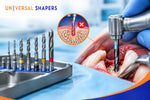
The gradual taper of a bullet shaped drill allows it to settle into the intended entry point before full engagement begins, which reduces the tendency of the tip to skate across curved or angled bone. In guided surgery, where drills pass through a sleeve, this initial centring accuracy has an outsized effect on the final implant position. The self-centring behaviour of bullet shaped drills supports closer alignment between the planned digital position and the actual osteotomy, particularly during the first pass.
Bullet shaped drills are used in both freehand and guided protocols. They are especially relevant for sloped ridges, narrow alveolar crests, or cases where precise entry point control matters, such as immediate implant placement adjacent to natural teeth.
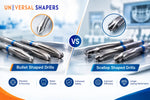
Bullet Shaped Drills vs Conventional Implant Drills
When comparing the two designs directly, several clinical factors stand out.
-
Initial positioning accuracy. The rounded tip of a bullet shaped implant drill tends to hold its position at the entry point more reliably than a flatter conventional tip, which can drift before it fully engages bone.
-
Osteotomy precision. Because the bullet shaped drill maintains a more consistent trajectory from the first point of contact, the resulting osteotomy often tracks closer to the planned angulation, particularly in guided workflows.
-
Heat generation. Both drill types generate heat during cutting, and irrigation protocol plays a larger role in temperature control overall. That said, the progressive engagement of a bullet shaped drill can reduce localized friction at the initial contact point.
-
Bone preservation. The gradual cutting action of bullet shaped drills is designed to limit unnecessary bone removal at the entry point, supporting better preservation of the surrounding cortical structure.
-
Surgical efficiency and ease of use. Conventional drills are familiar and quick for experienced clinicians. Bullet shaped drills can streamline the initial drilling phase by reducing correctional passes, though new users may need a short adjustment period to learn the technique.
-
Clinical predictability. Predictability during osteotomy preparation contributes to more consistent implant positioning, which supports favorable prosthetic and esthetic outcomes over time.
Comparison Table
|
Feature |
Bullet Shaped Drill |
Conventional Implant Drill |
|
Initial Stability |
Higher, due to self-centring tip |
Variable, depends on operator control |
|
Precision |
Strong trajectory tracking, especially guided cases |
Reliable with experienced technique |
|
Bone Preservation |
Gradual engagement supports preservation |
Depends on drilling speed and technique |
|
Heat Control |
Reduced friction at initial contact |
Requires strict irrigation protocol |
|
Ease of Use |
Short learning curve for new users |
Familiar to most clinicians already |
|
Clinical Applications |
Guided surgery, sloped ridges, precise entry cases |
Broad range of standard implant cases |
Benefits of Using Bullet Shaped Drills
Several practical advantages explain why more clinicians are incorporating bullet shaped drills into their protocols.
-
Improved centring during the initial drilling phase
-
Better surgical control on curved or sloped bone surfaces
-
More predictable osteotomy preparation across varying bone densities
-
Reduced risk of drill slippage at the entry point
-
A more efficient workflow with fewer correctional passes
-
Consistent clinical performance across different case types
These benefits are most noticeable where entry point accuracy has a direct impact on the final restorative outcome, such as anterior single-tooth implants or guided full-arch procedures.
When Conventional Implant Drills May Still Be Suitable
Conventional drills continue to play an important role, and choosing one design over the other is not always straightforward. Several factors influence when a conventional drill remains the right choice:
-
Clinical protocol. Some implant systems are validated with a specific drill sequence built around conventional geometry.
-
Implant system compatibility. Certain systems are engineered around conventional drill dimensions and depth markings.
-
Bone quality. In very soft bone, a conventional drill's cutting action may already provide sufficient control.
-
Surgeon preference. Clinicians experienced with conventional drills may achieve excellent results without changing their approach.
-
Specific treatment requirements. Certain sinus lift or ridge augmentation procedures follow protocols built around conventional instrumentation.
A balanced perspective recognizes that both drill types have earned their place in implant dentistry, and the decision often comes down to the specific case and system in use.
Choosing the Right Implant Drill for Your Practice
Selecting between a bullet shaped drill and a conventional drill involves weighing several practical considerations:
-
Clinical experience. Newer clinicians may benefit from the added stability a bullet shaped implant drill provides during the learning phase.
-
Implant system compatibility. Confirm that any new drill design is validated for your existing implant system.
-
Case complexity. Sloped ridges, narrow crests, and guided cases often benefit from the self-centring properties of bullet shaped drills.
-
Surgical workflow. Consider how a new drill type fits your existing sequence without adding unnecessary steps.
-
Instrument quality. Precision manufacturing affects how consistently a drill performs across repeated use and sterilization cycles.
-
Manufacturer support. Reliable technical guidance and clear documentation make it easier to integrate a new instrument into practice.
Manufacturers such as Universal Shapers design instruments with these clinical considerations in mind, offering dental professionals a range of drill geometries suited to different procedural needs.
Why Precision Instruments Matter
Regardless of which drill design a clinician chooses, instrument quality has a direct bearing on clinical outcomes. Precisely manufactured drills cut more consistently, generate less unwanted heat, and hold their geometry over repeated sterilization cycles. High-quality instrumentation contributes to:
-
Better treatment outcomes through more predictable osteotomy preparation
-
Greater procedural confidence, particularly in complex or guided cases
-
Long-term reliability across repeated clinical use
-
Practice efficiency, since well-designed instruments reduce correctional steps
Companies like Universal Shapers focus on precision engineering for implant drills, reflecting a broader industry shift toward instrumentation that supports both surgical accuracy and everyday practicality.
Conclusion
Both bullet shaped drills and conventional implant drills have a place in modern implantology. Conventional drills offer familiarity and broad compatibility across systems, while bullet shaped implant drills provide notable advantages in initial stability, entry point precision, and guided workflow accuracy.
The ideal choice depends on clinical objectives, the surgical protocol in use, and practitioner preference. As drill design continues to advance, clinicians have more tools available to refine their approach to osteotomy preparation and support predictable, patient-centred outcomes.
For dental professionals interested in exploring precision-engineered options, Universal Shapers offers a range of implant instruments designed for modern implant dentistry.